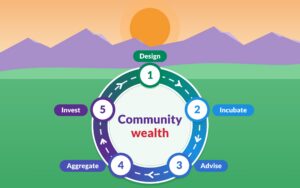
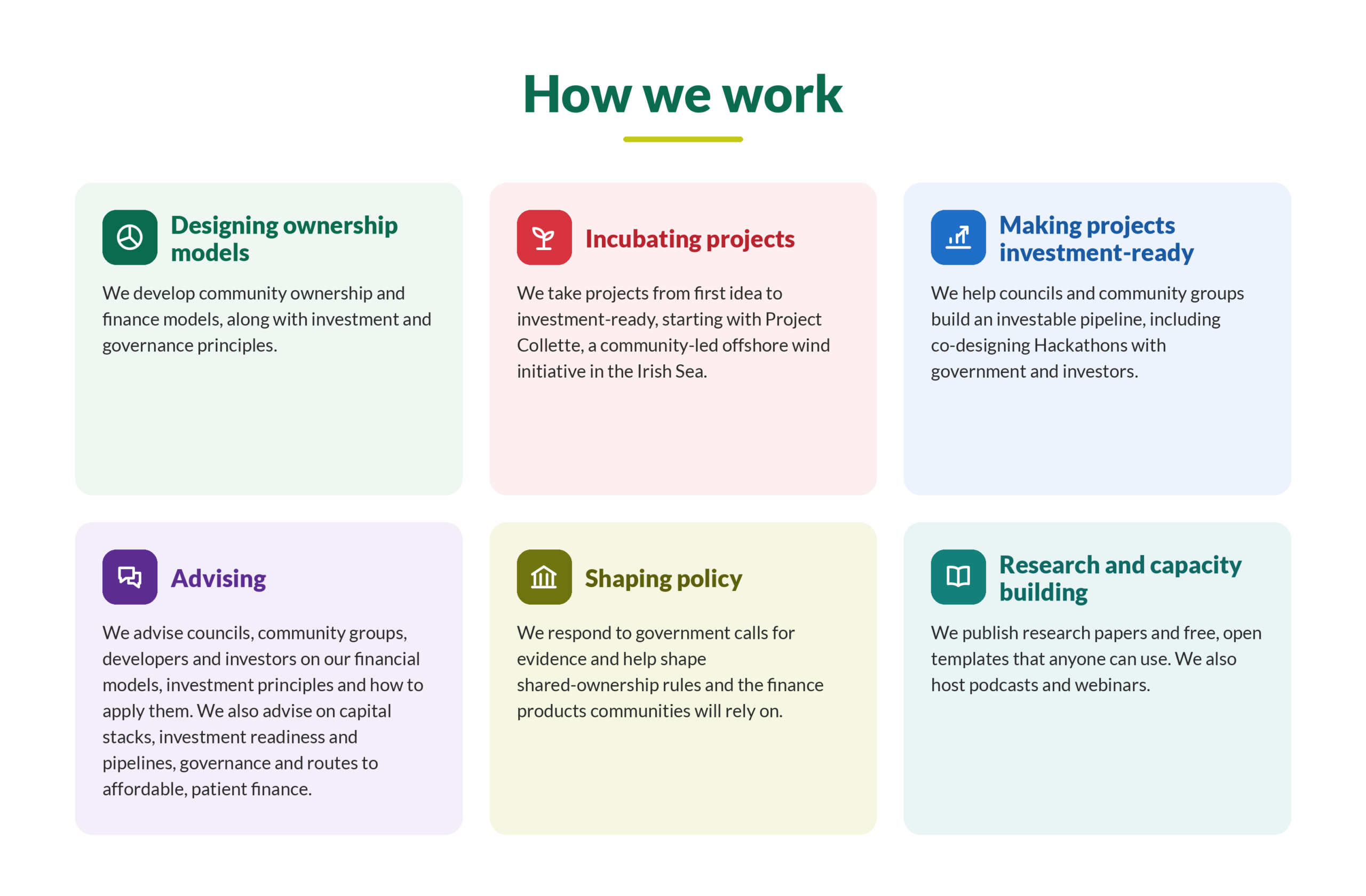
We start with the project, not the money: we aim to work alongside councils, community groups and developers to understand what they want to build and who should benefit. From there we design the finance, combining public, private and community capital into structures that make clean energy projects investable while keeping ownership and returns rooted locally.
Our aim is simple: turning clean energy into common wealth for the places that host it.
Our Ownership Models
Our Funding Model
Grants fund our new ideas and project incubation. Fees fund our proven expertise, with advisory services on investment readiness, community finance for government, councils, developers and investors. Either way, community wealth building is at the heart of what we do.
In 2024, the Hub received a grant from the Climate Change Collaboration and a Stage 1 grant from the Community Energy Fund (CEF), followed in 2025 by a Stage 2 CEF grant. Together, these three grants have funded for Project Collette an initial business plan, a feasibility study, a concept grid study, initial and detailed finance models, the development of our Community Integrated Investment Model (CIIM), our toolkit on making energy ownership accessible for all, our community finance report, a community survey and community engagement workshops with a report on the findings. They have also supported multiple policy submissions, engagement with the community, the Government, Crown Estate, GB Energy and investors.
In 2022/23, a small development grant from the Friends Provident Foundation kept the Hub afloat. Before that, in 2021, the Quadrature Climate Foundation funded our Green Investment Plan for Cumbria, where it all began.
Who We Work With
Government, councils delivering Local Area Energy Plans, community energy groups and co-operatives, and coastal and rural communities with clean energy potential and natural assets on their doorstep. We also work with developers, impact investors and pension funds who want to back local clean energy projects.
